
When I came across an eastern white pine tree that someone had chopped up and abandoned, I figured I’d do something with it. I had the same idea when I came across some downed black cherry wood. But since I have no woodworking skills, I knew I’d have to do folkcraft-quality work. Ultimately, I settled on making white pine bookends and a black cherry hot pad. Here’s the simple way I worked on them.
(RELATED: Man vs. Women in ‘Thor vs. the Valkyries’)
White Pine Bookends
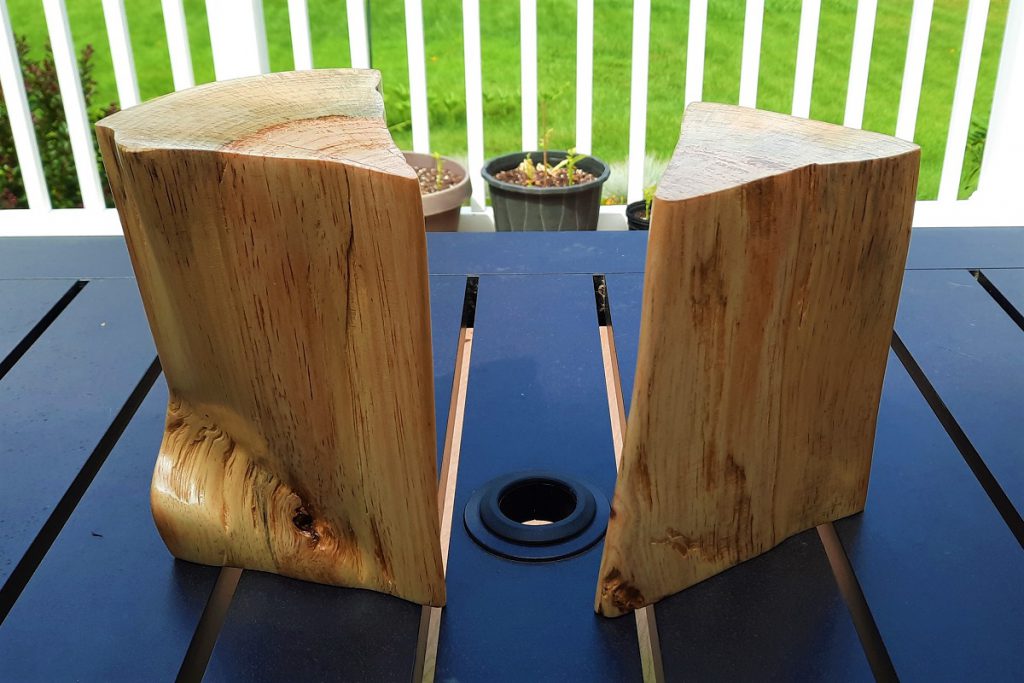
Splitting firewood is one of my favorite pastimes. Fiction writing is another. And since white pine has a reputation of being a great wood to work with, I decided to make white pine bookends that resemble pieces of firewood.
So I split a white pine log into four pieces using a wood-splitting maul. This resulted (as you might guess) in a lot of cracks and fractures running through the split wood. It also created some interesting, random shapes. After that, I cut those pieces in half so that they’d fit on a bookshelf. Next, I selected the two that I thought were the best pieces and started sanding them by hand.
I worked my way through sandpaper grits starting with 60 and ending around 220 (give or take). I wanted a rustic look to the bookends and so I didn’t care about getting the entire surface of either piece in great shape. So there are still plenty of areas of roughness, discoloration, and even tracks from grub damage on the wood. In short, I wanted the bookends to look like firewood but without potential splintering and splinters.
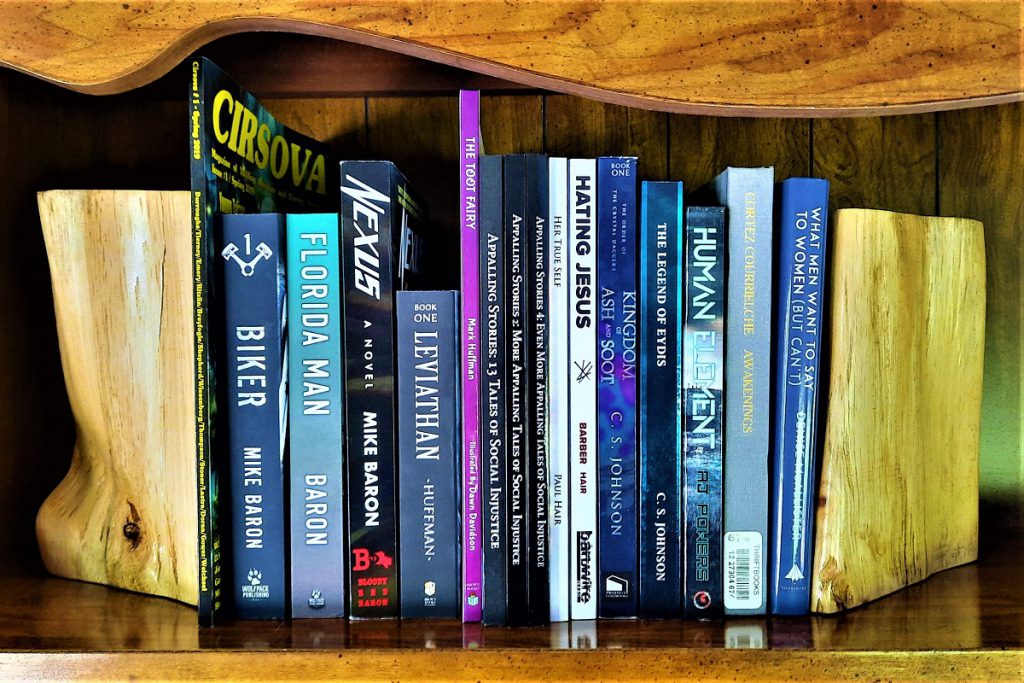
The toughest part of the sanding came from there being sap still left in the white pine. That resulted in clogging of the sandpaper rapidly occurring. And this in turn greatly extended the amount of time it should’ve taken me to sand. Ultimately, though, I didn’t really care, because I enjoyed sanding the pieces.
For the final step, I chose to cover the bookends in a clear-coat polyurethane. And since they are for indoors use only, I chose a water-based polyurethane so clean-up would be easy. I applied four coats and they came out with a nice gloss that is smooth to the touch.
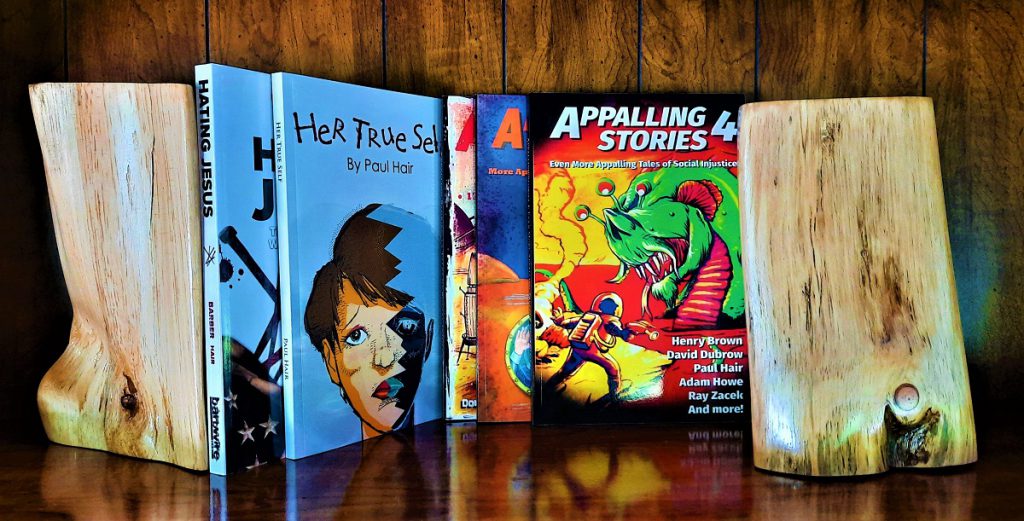
I’m highly pleased with the final result. I learned things and there are things I’d do differently if I work on something similar again. But for being a first-time project and for having no woodworking skills? I’m highly satisfied with the bookends and I’ve put them to good use on my bookshelf. And make sure you check out all the books I’ve written.
Black Cherry Hot Pad

The other folkcraft woodworking project I did was a rustic, black cherry hot pad with a live edge. My original plan was to leave all the bark on. But because the wood was somewhat old when I found it, and because I didn’t know the proper way to preserve it before I started, some of it fell off while I worked on it. Also, cracks formed in the wood because I didn’t preserve it. But none of those things really bothered me. After all, it’s supposed to be rustic folkcraft.
The steps for the black cherry hot pad were pretty much the same as with the white pine bookends. Of course, because I wanted to retain the live edge, I didn’t sand that part with the exception of the portions where the bark fell off. In those areas, I lightly sanded them to remove bits of residual bark and any dirty spots.
Also, with the hot pad, I went the whole way up to a 400 grit sandpaper on the surface, which gives it a nearly glass-like feel. In the end, that was not really worth it because I put a clear-coat polyurethane on it (more on that in a bit). I had originally considered not finishing it at all so it would retain that ultra-smooth feel.
The reason I ended up putting the clear-coat polyurethane on it is for stain protection. In other words, if food would splash on the hot pad or it otherwise becomes dirty, it’s now easy to simply wipe it off. Without the finish, stains would likely sink into the wood and it would be difficult to clean.
As with the white pine bookends, I learned things along the way of working on the black cherry hot pad. But I ultimately am pleased with it.

Working with wood at the folkcraft level was fun. I think I’ll keep doing it.
All images © 2021, Paul Hair.